

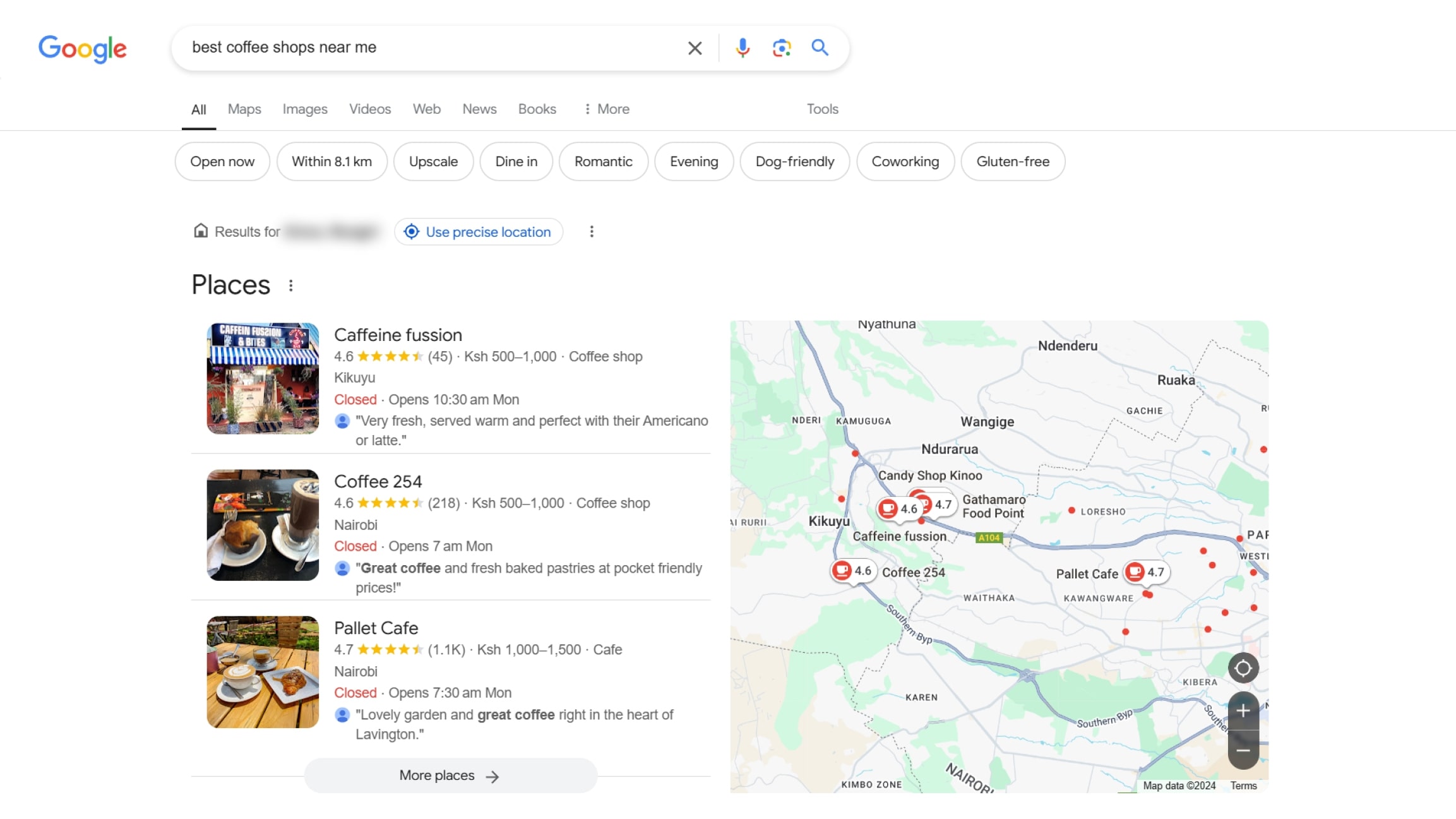
If you have ever searched "best coffee shops near me" and picked one of the top three results, you already understand local SEO, even if you have never heard the term.
Key takeaways
Local SEO helps nearby customers find your business when they search on Google, Google Maps, or AI assistants such as ChatGPT and Gemini.
Google ranks local businesses on relevance, proximity, and prominence.
76% of people who search for something nearby visit a business within 24 hours (Backlinko, citing Google data), making local search one of the highest-intent marketing channels.
Smartphones account for 63.7% of all connected mobile devices in Kenya (Communications Authority of Kenya, Q1 2026), so your website must work on a phone.
The fastest wins: a complete Google Business Profile, consistent business details across platforms, and a steady flow of reviews.
What is local SEO?
Local SEO is the process of improving a business's visibility for location-based searches, so it appears among the top results when someone nearby looks for what it offers.
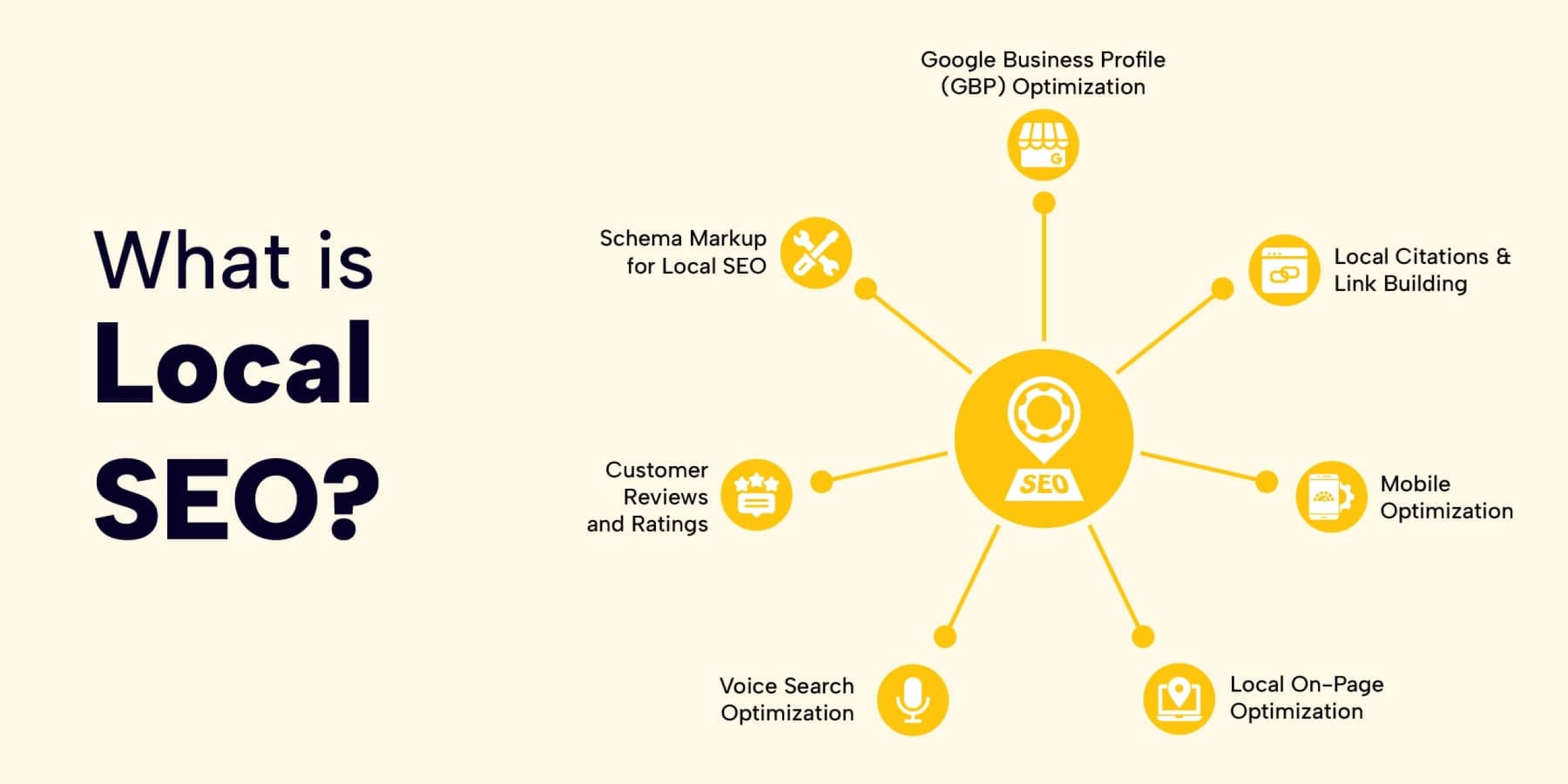
Examples of local searches in Kenya:
Best nyama choma in Rongai
Pharmacy near Kenyatta Market
Affordable mechanic in Mombasa
Someone typing "pharmacy near Kenyatta Market" usually needs one immediately. Local SEO puts your business in front of that person before a competitor does.
Local SEO vs traditional SEO
Local SEO | Traditional SEO | |
Target audience | Customers in a specific town, estate, or region | National or global audience |
Search intent | Strong, often ready to visit or call | Mixed, often research stage |
Competition | Lower, limited to nearby businesses | Higher, national, and international sites |
Typical result | Google Maps pack, local pack, GBP listing | Organic search results |
Example keyword | "Lawyer in Machakos" | "Corporate lawyer Kenya" |
Conversion speed | Fast, often the same day | Slower, longer decision cycle |
How Google ranks local businesses
Google's own explanation of local ranking lists three factors:
Relevance: how well your business matches what the searcher typed.
Proximity: how close you are to the person searching.
Prominence: how well known and credible your business is, based on reviews, backlinks, and citations.
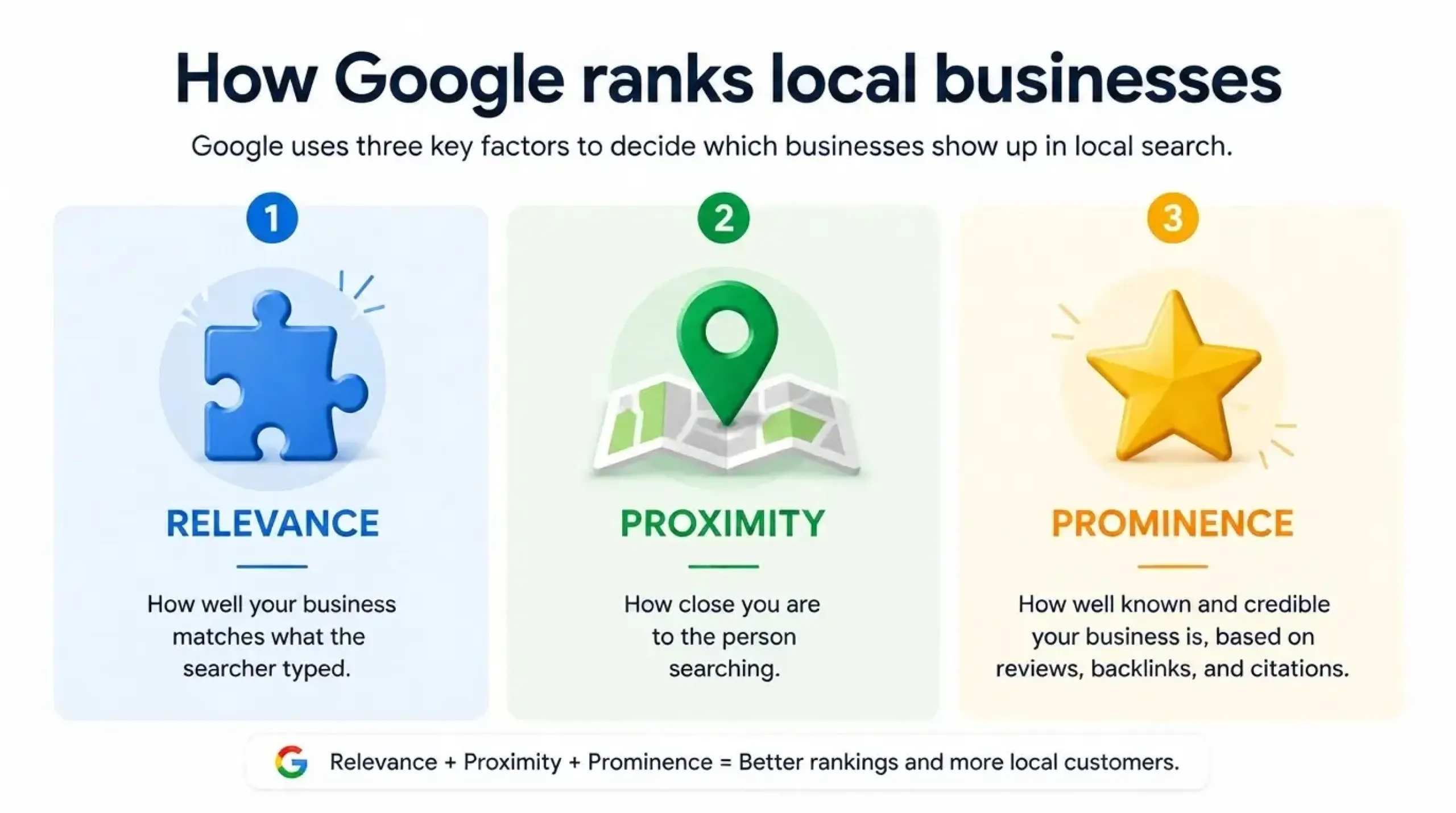
You cannot change proximity. You can do a lot about the other two. Whitespark's Local Search Ranking Factors survey has found, year after year, that your Google Business Profile category and the completeness of your listing matter more than almost anything else, along with reviews and on-page relevance.
Why local SEO matters in Kenya
The feature phone is dying. As of March 2026, smartphones made up 63.7% of the 78.7 million devices on Kenyan networks: over 50 million smartphones against 28.5 million feature phones, per the Communications Authority of Kenya's latest sector report. Subscribers are also switching from 2G and 3G to 4G and 5G. More of your customers can now load image-heavy pages and maps, but only if your site is built for small screens and patchy connections.
A quick check for your own site:
Does it load in under three seconds on a mid-range Android handset, not only on fast Wi-Fi?
Can you tap every button comfortably with a thumb?
Do your Google Business Profile and website both show a working phone number and a click-to-WhatsApp link? WhatsApp already handles much of Kenyan commerce.
"Near me" searches keep growing, too. A shopper in Westlands looking for a restaurant will tap one of the top-rated results in the local pack. They will not scroll to page two.
Unlike billboards or radio slots, local SEO is trackable to the keyword, the click, and the call. A well-optimised shop in Nakuru can outrank a national chain for local searches.
Step-by-step local SEO strategy for Kenyan businesses
1. Start with smart keyword research
Combine your service or product with a specific town, estate, or landmark:
Lawyer in Machakos
Car repair shop in Kisumu
Boda boda spare parts Nairobi
Tools worth using include Google Keyword Planner (free), Ubersuggest (affordable), and Ahrefs or Semrush for competitor gap analysis.
Swahili and Sheng keywords
Most Kenyans search in English, but not everywhere. Along the coast, people are more likely to type "saluni ya nywele Mombasa" than "hair salon Mombasa". In Nairobi, Sheng and code-switched phrases appear in voice searches and social captions even when typed searches remain in English.
If that describes your audience:
Add a Swahili or Sheng version of your business description to your Google Business Profile.
Include a short Swahili phrase in your alt text or FAQ where it matches how people search. Do not translate the whole page.
Check real query volume with Keyword Planner set to Kenya before committing.
Skip forced translations. An awkward Swahili phrase hurts trust more than it helps visibility.
2. Optimise your Google Business Profile (GBP)
Your Google Business Profile is usually the first thing a customer sees on both Search and Maps.
To claim and verify: visit Google Business Profile, create or claim your listing, enter your business name, address, and phone number exactly as you use them everywhere else, then verify by phone, email, video, or postcard, depending on what Google offers for your category.
Fill in everything:
Business hours, updated for public holidays.
Photos and short videos of your products, premises, or team.
The correct primary category, for example, "Restaurant" or "Real estate agency".
Attributes such as parking, wheelchair access, or delivery.
Then keep it active. Google favours listings that post updates, add photos, and reply to reviews quickly. A dormant profile signals to Google and customers that the business might be inactive.
3. Create a page for every location you serve
If you operate in more than one town, build a landing page for each. A cleaning company with teams in Nairobi, Mombasa, and Kisumu needs three pages, each with testimonials from local customers, area-specific pricing, and an embedded Google map.
4. Manage your local citations
A citation is any online mention of your business's name, address, and phone number (NAP). Treat your Google Business Profile as the master record; every other listing should match it exactly, including abbreviations. Inconsistent details quickly lose Google's trust.
Directories worth listing on: Facebook Business Page, Bing Places, Apple Business Connect, TripAdvisor for hospitality, Yellow Pages Kenya for service businesses, and Yelp for international credibility.
5. Encourage and respond to reviews
Roughly three in four consumers regularly read online reviews before choosing a local business (Backlinko, citing BrightLocal survey data). Reviews also feed directly into Google's prominence factor.
Ways to get more:
Ask politely, in person or by message, right after service.
Share a WhatsApp link that takes the customer straight to your review page.
Add a review widget to your website.
Print a QR code on receipts, menus, or invoices.
Reply to every review. Thank the good ones, answer the bad ones calmly, and never buy or fabricate reviews. Google detects fake reviews and penalises them. Its helpful content guidance rewards first-hand, honest material over generic or incentivised content. The same applies to your blog and FAQ content.
6. Optimise for mobile and voice search
Most local searches in Kenya happen on a phone, and a growing share are spoken to Google Assistant rather than typed. Voice queries sound like real speech, so write FAQ content the same way: "Where can I find an electrician in Thika?" These conversational questions are also the ones most likely to surface in AI-generated answers.
7. Build local backlinks
Backlinks from trusted, relevant sources signal authority. In Kenya, that can mean partnering with local bloggers, sponsoring a community football tournament, listing with the Kenya National Chamber of Commerce and Industry, or getting featured in Nation, Standard, or Bizna Kenya.
8. Use schema markup
Schema markup is structured code that tells Google and increasingly AI systems exactly what your business is. Add at minimum:
LocalBusiness schema: name, address, phone, hours, category.
FAQPage schema for any FAQ section.
Review schema where you have genuine customer reviews to display.
9. Use social media for local visibility
WhatsApp Business works for showcasing products and answering queries directly. Facebook Shops suits small retailers. Instagram and TikTok carry the most weight for food outlets, salons, and fashion. Whatever you post, tag your location and use local hashtags such as #NairobiEats or #MadeInKenya.
10. Track and measure results
Google Analytics: which pages attract local traffic and how they convert.
Google Search Console: Which keywords bring impressions and clicks?
Google Business Profile Insights: how customers found your listing and whether they called, visited, or asked for directions.
Worked example: a Nairobi hardware shop
A hardware shop in Kasarani (a composite drawn from small retail clients we have worked with) had a claimed but dormant Google Business Profile, mismatched details across directories, and unanswered reviews. Over three months, the shop:
Completed and verified its profile, added 20 photos, and set accurate weekly hours.
Corrected its name, address, and phone number in five directories where it was listed inconsistently.
Started asking every in-store customer for a Google review and replying within 48 hours.
Clicks and calls for "Get directions" rose steadily in Profile Insights, and the shop climbed into the local pack for its core categories. The exact numbers matter less than the pattern. Profile activity, clean citations, and review management moved the needle faster than anything else the shop could have done.
Common local SEO mistakes and how to fix them
Mistake | Why it hurts | Fix |
Not asking for reviews | Fewer trust signals for customers and Google | Build a simple, repeatable request process after every sale |
Inconsistent business details across listings | Confuses Google and can suppress ranking | Audit every directory and match the name, address, and phone number exactly. |
Relying only on social media, with no website | Limits credibility and control over your own content | Build a simple, fast, mobile-friendly website alongside your social profiles |
Ignoring Swahili or Sheng search terms | Misses genuine local search demand | Add local-language terms to your GBP description and FAQ so they match real searches. |
Not optimising for mobile | Loses customers on slow or broken pages | Test load speed on an actual mid-range Android phone, not a desktop browser |
Frequently asked questions
How long does local SEO take to show results in Kenya?
A few weeks to several months, depending on how competitive your category and area are and how consistently you keep your profile, citations, and reviews up to date.
Can small businesses compete with large companies in local search?
Yes. A small business with an active, accurate, well-reviewed profile can outrank a national competitor that never bothered with local optimisation.
Do reviews affect local SEO rankings?
Yes. Google weighs the quantity, quality, and recency of reviews, and reviews also decide whether a customer picks you in the first place.
Is a website necessary, or is a Google Business Profile enough?
Use both. A website gives you credibility, control, and room for service pages, testimonials, and blog content that a profile alone cannot hold.
How much does local SEO cost for a small business in Kenya?
Anywhere from free (a self-managed Google Business Profile costs only your time) to an ongoing agency retainer covering citations, content, and reporting. Start with profile optimisation and review management. Both are cheap and high impact. Paid backlink or content campaigns can come later.
Where to start
Claim your Google Business Profile this week, fix your citations, and ask your next ten customers for a review. That alone puts you ahead of most competitors.
If you would rather have a specialist handle the audit, citation cleanup, and reporting, Cralite Digital's SEO team can run a free local SEO review of your listings and website and show you exactly where you are losing visibility.

