


In 2026, a business website in Kenya can cost from approximately KES 15,000 to more than KES 500,000. A professionally built small-business website usually falls between KES 30,000 and KES 150,000. E-commerce websites and custom platforms cost more due to payment integrations, product management, security, and other features.
At Cralite Digital, a standard business website starts from KES 30,000, while an e-commerce website typically starts from KES 60,000. Every project is priced individually based on its pages, design, content, features, and integrations.
Website type | Indicative cost | Typical scope | Best suited to | Estimated timeline |
Landing page | KES 15,000–40,000 | One focused page and an enquiry form | Campaign launches, events, product drops | 1–3 weeks |
Basic brochure website | KES 20,000–60,000 | Approximately 3–5 informational pages | Freelancers, consultants, new small businesses | 2–4 weeks |
Professional business website | KES 30,000–150,000 | Approximately 5–15 pages, CMS, blog and lead forms | Established SMEs building credibility and generating enquiries | 3–8 weeks |
Corporate website | KES 100,000–300,000+ | Multiple services, departments, locations and integrations | Larger organisations with several stakeholders | 6–12 weeks |
E-commerce website | KES 60,000–500,000+ | Product catalogue, checkout, payments and order management | Businesses selling products online | 6–16 weeks |
Custom web application | KES 250,000–1,000,000+ | Portals, dashboards, marketplaces and custom workflows | Businesses needing bespoke systems beyond a standard website | 3–6 months or more |
Website redesign | Scope-based | New design, migration, redirects and technical improvements | Businesses replacing an outdated or underperforming site | 4–12 weeks |
Swipe to see more →
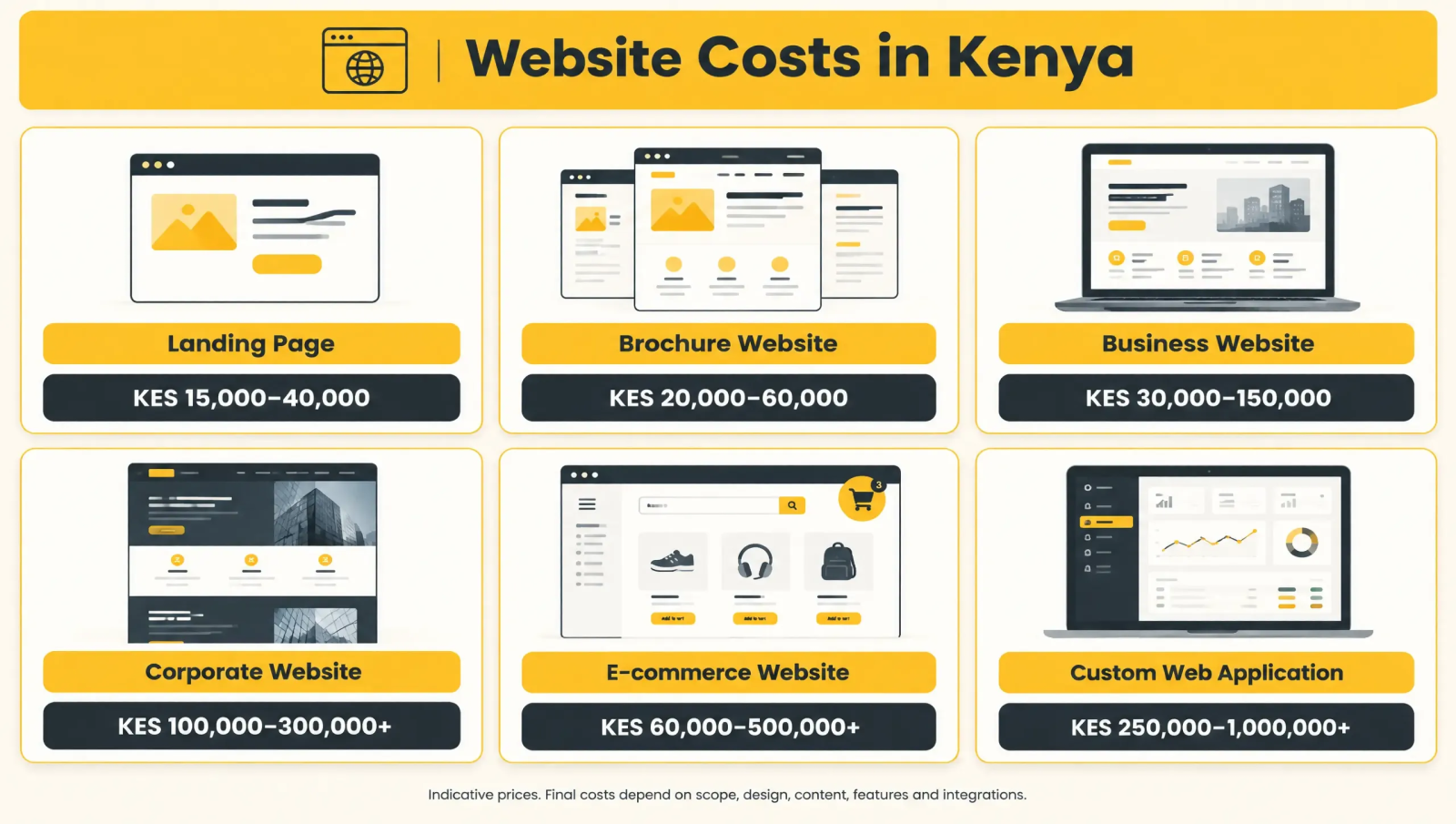
These ranges can overlap. A five-page custom website with professional copywriting, photography, and advanced integrations may cost more than a larger template-based website.
The important question is not only "how many pages do I need?" It's also "what must the website help my business accomplish?"
Key takeaways
Website prices depend on scope, functionality and included services, not page count alone.
Budget for the complete first-year cost, including hosting, maintenance, content and licences.
Compare quotations using their inclusions, exclusions, ownership terms, support and VAT status.
Start with features that support the main business goal, then add advanced functionality as the website grows.
How were these website cost estimates calculated?
These figures reflect publicly advertised website packages from Kenyan web design providers reviewed in September 2026, alongside Cralite Digital's starting rates and project-scoping experience. They are not drawn from an audit of every quote on the market. Treat them as a starting point rather than a substitute for an itemised quotation.
Large price differences often reflect variations in scope, experience, delivery model and post-launch support. A KES 30,000 quotation and a KES 90,000 quotation for the same five-page brief may not cover the same work. One may include copywriting, SEO setup, analytics, and several rounds of revisions. The other may include only design and development.
How much does a landing page cost in Kenya?
A professionally designed landing page in Kenya typically costs KES 15,000 to KES 40,000.
A landing page is built around one action, such as:
Requesting a quotation
Registering for an event
Downloading a resource
Booking a consultation
Purchasing a specific product
Joining a waiting list
The price may include custom design, mobile responsiveness, a contact form, basic analytics and on-page SEO. Copywriting, photography, payment integration, email automation and advertising tracking are often charged separately.
A landing page can be more valuable than a cheap multi-page website when it is designed around a clear campaign and conversion goal.
How much does a basic brochure website cost?
Budget KES 20,000 to KES 60,000 for a basic brochure website.
It commonly includes:
Home page
About page
Services or products page
Contact page
Enquiry form
Mobile-responsive layout
Basic content management
Basic search optimisation
Links to social media profiles
This option suits freelancers, consultants, small organisations and new businesses that need a professional online presence without advanced functionality.
Confirm whether the quotation includes content writing, website hosting, business email, analytics, security and ongoing support. A low headline price might cover only design and development.
How much does a professional business website cost?
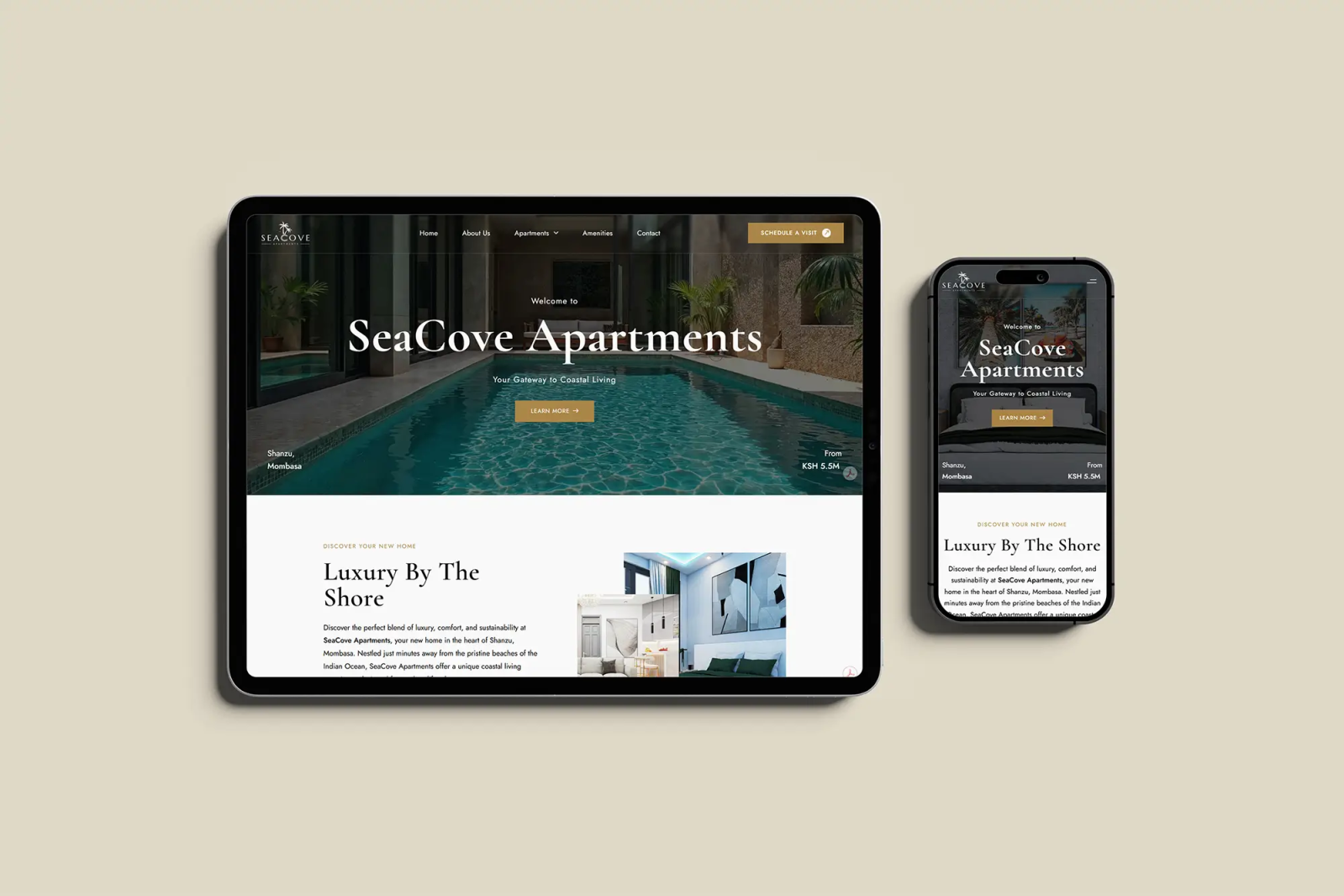
A professional business website in Kenya generally costs between KES 30,000 and KES 150,000. At this level, expect more than a few informational pages. The website should be designed to build trust, explain your services, and turn visitors into enquiries or customers.
A professional business website may include:
Customised website design
Five to fifteen pages
Individual service pages
Case studies or portfolio pages
Blog or resource section
Content management system
Enquiry and lead-generation forms
WhatsApp and call buttons
Google Analytics 4
Google Tag Manager
Google Search Console
Basic structured data
Technical SEO foundations
Speed and mobile optimisation
Training and post-launch support
The final quotation will depend on the number of pages, design complexity, content requirements and functionality.
How much does a corporate website cost?
Corporate websites cost more, usually KES 100,000 to KES 300,000 or more, because they tend to carry more stakeholders, content and technical requirements than ordinary SME websites.
They may need:
Multiple service or product divisions
Branch and location pages
Team profiles
News and investor sections
Document or resource centres
Careers and application forms
Approval workflows
Multilingual content
CRM and email integrations
Advanced analytics
Accessibility requirements
Enhanced security
Legal and compliance pages
The number of decision-makers can also affect the cost. More review stages, design revisions, and approval processes increase the time needed for project management.
How much does an e-commerce website cost in Kenya?
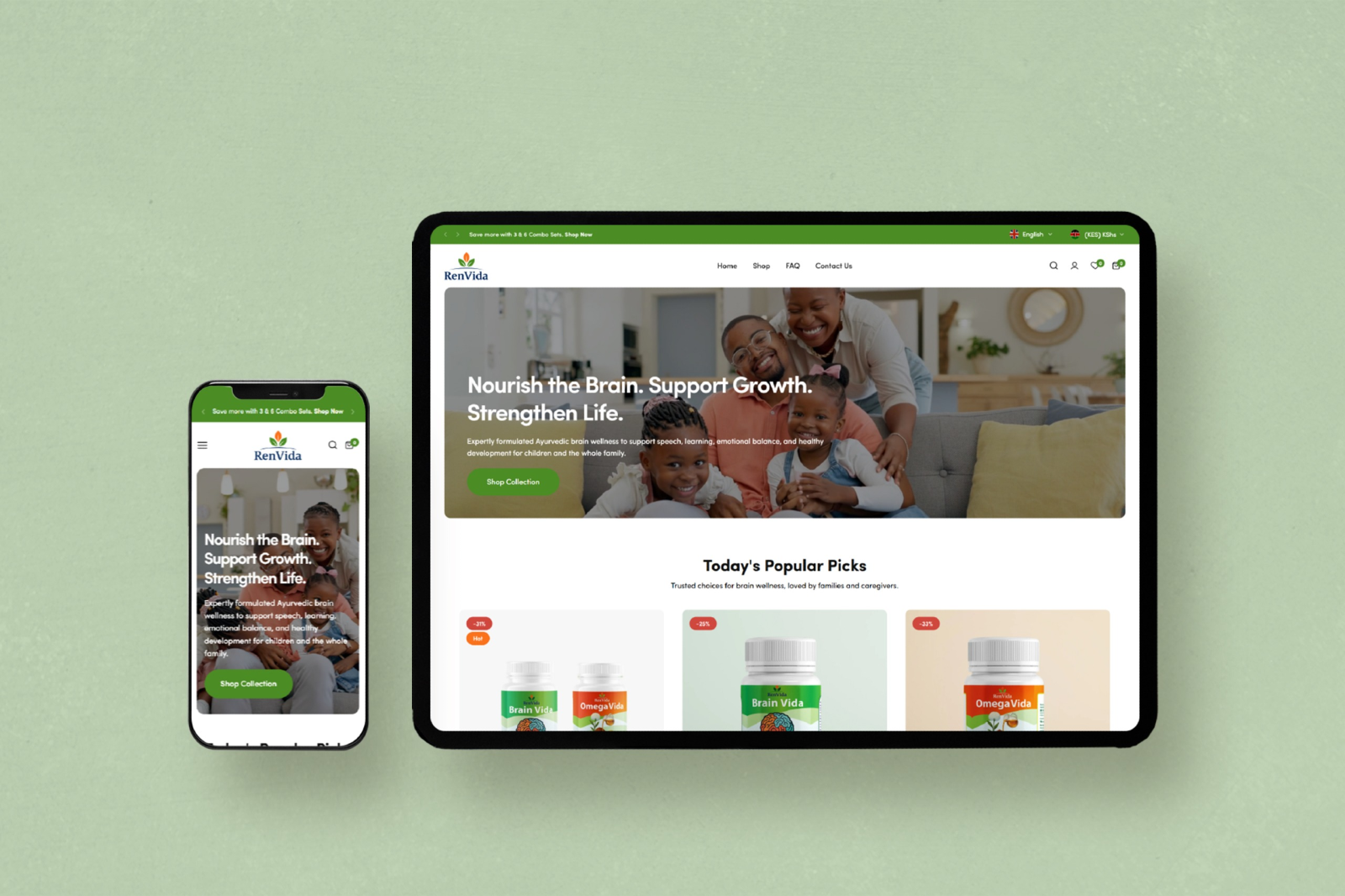
E-commerce has one of the widest price ranges, ranging from approximately KES 60,000 to over KES 500,000 for more advanced stores.
A small online shop with a limited catalogue and a straightforward checkout will cost less than a store with hundreds of products, multiple payment methods, delivery zones, stock synchronisation and customer accounts.
Common e-commerce requirements include:
Product and category pages
Shopping cart
Secure checkout
M-Pesa integration
Card payment integration
Inventory management
Delivery and collection options
Customer accounts
Order notifications
Product search and filters
Discount codes
Sales reporting
Abandoned-cart recovery
Product reviews
Multi-currency support
Safaricom’s Daraja platform provides APIs for connecting M-Pesa payments to websites and applications. Although the API is available to developers, live integration requires development, configuration, security checks and testing.
The number of products, payment methods, and additional integrations will determine the final cost of the e-commerce website in Kenya.
How much does a custom website or web application cost?
Custom platforms sit outside standard website pricing. They can start at approximately KES 250,000 and exceed KES 1 million for complex builds.
These platforms support specific business processes rather than simply presenting information. Examples include:
Customer or member portals
Booking and reservation platforms
Property listing websites
Learning management systems
Multi-vendor marketplaces
Subscription platforms
Business dashboards
Quotation systems
Custom directories
Inventory and workflow systems
The quotation will depend on the number of user roles, workflows, dashboards, reports, integrations, and security requirements.
Complex platforms should begin with a discovery phase that defines the requirements, user journeys, technical architecture and development stages before the full project starts.
How much does a website redesign cost in Kenya?
Website redesign costs vary widely because a redesign may involve far more than just changing colours, fonts and layouts.
The price depends on whether the project includes:
A new visual design
Revised website structure
New content
Content migration
CMS migration
New features
Mobile improvements
Performance optimisation
Accessibility improvements
Analytics migration
URL changes
Technical SEO work
If existing URLs change, the project should include a 301 redirect map. This directs visitors and search engines from old pages to their most relevant replacements. Missing redirects can lead to broken links, lost rankings, and reduced organic traffic.
A complex redesign can cost nearly as much as a new website because the team must audit and migrate existing content before building the new experience.
What factors determine website development costs in Kenya?
Two businesses can request websites with the same number of pages and receive very different quotations. The difference usually comes down to scope, design quality, functionality and included services.
How does the number of pages affect the price?
Each page may require research, copywriting, design, images, metadata, internal links, development and testing.
A website with separate pages for ten services requires more work than one combining all services on a single page. However, separate service pages may better help potential customers searching for individual services.
The cost may also increase when each page requires a unique layout rather than a set of reusable templates.
Does custom design cost more than a template?
Template-based websites generally cost less because the main layout already exists. The designer customises its colours, fonts, images and content to match the business.
Custom website design starts with the company’s goals, customers, brand and user journeys. It can provide greater flexibility and differentiation, but it requires more strategy and design time.
A template is not automatically a poor choice. It may suit a small business with standard requirements and a limited budget. More important questions are whether it is mobile-friendly, fast, easy to manage, and suitable for the intended customer journey.
How does functionality affect the cost?
Every additional feature requires development, configuration and testing.
Features that can increase website development costs include:
Online payments
Booking calendars
Quote calculators
Customer accounts or membership areas
Product search and filters
Multilingual functionality
CRM and email integrations
Third-party APIs
Before requesting a quotation, separate essential features from those that can be added in a later phase.
How does content affect the price?
Some quotations assume that the client will provide all text, images and videos in a publish-ready format.
If content is not ready, the project may also require:
Keyword and audience research
Website copywriting
Editing and proofreading
Product descriptions
Photography
Video production
Illustrations or graphics
Content migration
Image optimisation
Content uploading
Preparing content early can shorten the development timeline and lower unexpected costs.
Do SEO and GEO increase website costs?
Basic SEO should be part of a professionally built business website, but extensive SEO and content strategy are normally separate services.
Generative Engine Optimisation, or GEO, is becoming an additional consideration for businesses that want their information to be understood and cited by AI-powered search platforms such as Google AI Overviews, ChatGPT Search and Perplexity.
A strong SEO foundation may include:
Crawlable page content
Logical website architecture
Clean URLs
Heading structure
Internal linking
Canonical tags
Mobile optimisation
Page-speed improvements
GA4, Search Console and Google Tag Manager configuration
A website intended to appear in AI-generated answers should present important information in clear, indexable text. Service descriptions, prices, FAQs, company details, and evidence of expertise should not be hidden in images or in elements that require JavaScript to load.
Google states that there are no separate technical requirements or special schema types for appearing in AI Overviews and AI Mode. The same SEO and people-first content practices continue to apply.
Special AI-only markup should therefore not be presented as a requirement for appearing in Google’s AI features. Effective GEO involves technically accessible content, clear information architecture, accurate structured data, entity consistency and credible evidence.
Cralite provides SEO and AI search services for businesses that need ongoing search visibility, content strategy and performance monitoring.
How do performance and security affect the cost?
Performance and security work may include image compression, caching, code optimisation, SSL configuration, backups, software updates, malware monitoring and security testing.
These requirements add development time, infrastructure or ongoing maintenance. Ask if they are included in the initial quotation or provided through a recurring support plan.
What are the one-time and recurring website costs?
A website usually has both initial and ongoing expenses.
One-time or project costs | Recurring costs |
Strategy and discovery | Domain renewal |
UX and interface design | Website hosting |
Website development | Business email |
Copywriting and photography | Software and plugin licences |
Content uploading | Maintenance |
Content migration | Backups and security monitoring |
Payment and system integrations | Content updates |
Initial SEO configuration | SEO and digital marketing |
Analytics setup | Payment-processing charges |
CMS training | Third-party platform subscriptions |
Swipe to see more →
How much do a domain and hosting cost in Kenya?
A domain may cost approximately KES 1,000 to KES 4,000 per year, depending on the extension and registrar.
Basic shared hosting may cost approximately KES 3,000 to KES 15,000 per year. Managed, cloud, or VPS hosting can cost considerably more.
Don't compare hosting packages on price alone. Consider:
Renewal price
Storage
Traffic limits
Backups
Security
Email accounts
Technical support
Server location
Uptime
Scalability
Some introductory prices apply only during the first year. Check renewal costs before purchasing.
How much does website maintenance cost in Kenya?
Website maintenance can range from KES 2,000 to KES 20,000 per month, depending on the scope of work.
A maintenance plan may cover:
Software updates
Backups
Security monitoring
Broken-link checks
Small content changes
Performance monitoring
Technical support
Reporting
New pages, features and major content updates may be charged separately. Ask the provider to distinguish between routine maintenance, content updates and new development.
What does a realistic first-year website budget look like?
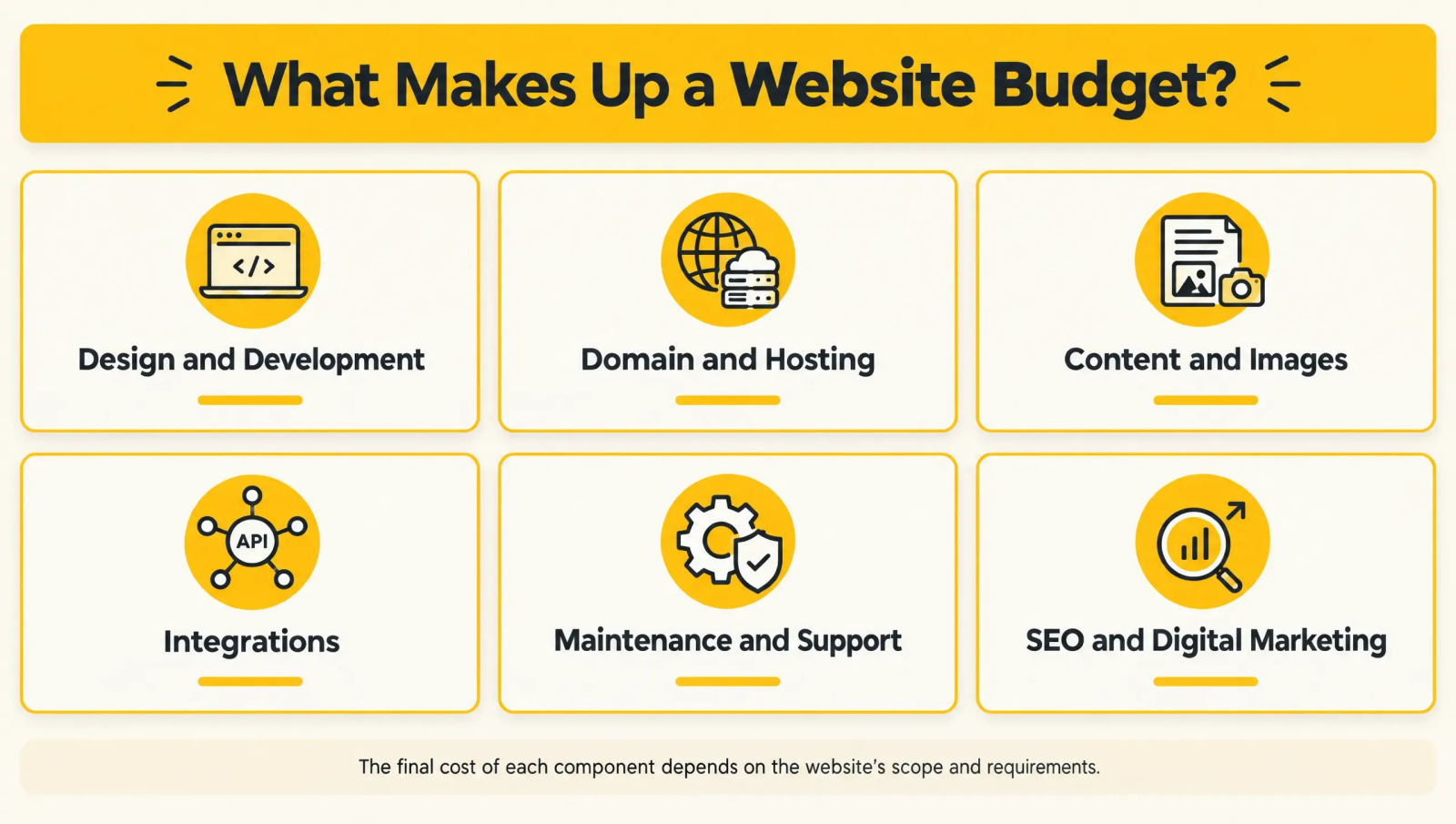
The development fee should not be treated as the entire website budget. The following examples show how other requirements can affect the total first-year cost.
Scenario 1: A small professional-services business
The business needs a five-page website with a contact form, a WhatsApp button, and a basic SEO setup.
Item | Illustrative budget |
Design and development | KES 30,000–60,000 |
Domain and hosting | KES 4,000–12,000 |
Copywriting or editing | KES 5,000–20,000 |
Maintenance and support | KES 0–30,000 |
Estimated first-year total | KES 39,000–122,000 |
Swipe to see more →
Scenario 2: An established SME
The business needs custom design, ten or more pages, a blog, service pages, case studies, analytics and conversion tracking.
Item | Illustrative budget |
Strategy, design and development | KES 70,000–150,000 |
Content and images | KES 20,000–60,000 |
Domain and hosting | KES 6,000–20,000 |
Maintenance and support | KES 24,000–120,000 |
Estimated first-year total | KES 120,000–350,000 |
Swipe to see more →
Scenario 3: An e-commerce business
The business needs an online shop with product uploading, M-Pesa, delivery options and order management.
Item | Illustrative budget |
Design and development | KES 60,000–300,000 |
Product content and uploading | KES 10,000–100,000 |
Payment and delivery integrations | KES 10,000–80,000 |
Domain and hosting | KES 10,000–40,000 |
Maintenance and support | KES 36,000–180,000 |
Estimated first-year total | KES 126,000–700,000 |
Swipe to see more →
These examples are not quotations. They show how scope and ongoing services affect the total cost.
Should you use a DIY builder, a freelancer, or a web design agency?
The right provider depends on the project’s size, complexity, budget and support requirements.
Option | Best suited to | Main advantage | Main limitation |
DIY website builder | Simple sites and early-stage ideas | Low initial financial cost | Requires your time and may limit customisation |
Freelancer | Small or clearly defined projects | Flexible and potentially affordable | Capacity, availability and support vary |
Web design agency | Business, corporate and e-commerce projects | Access to design, development, content and SEO skills | Higher initial investment |
In-house team | Businesses with continuous development needs | Direct control and availability | Salaries, tools and management increase costs |
Swipe to see more →
A freelancer is not automatically less capable than an agency, and an agency is not always the right choice for every business. Compare available expertise, processes, support, and scope rather than choosing based on provider type alone.
Should you choose WordPress, a website builder or custom development?
Website builders such as Wix or other hosted platforms can work for businesses that need to launch quickly and manage standard features themselves.
WordPress can support blogs, corporate websites and e-commerce stores through themes, plugins and custom development. Its cost depends on how much design and functionality is customised.
Custom development is appropriate when the website needs unique workflows or integrations that standard platforms cannot handle efficiently.
When comparing platforms, consider:
Initial development cost
Monthly subscriptions
Premium licences
Ease of editing
Ownership and portability
Availability of developers
Security and maintenance
Integration requirements
Long-term scalability
Avoid selecting technology based only on a developer's preference. The platform should fit the business requirements and the team that will manage it.
How can you get an accurate website quotation?

A useful quotation should explain what will be delivered, what will be excluded, and what the business will continue to pay for after launch.
What should your website brief include?
Prepare a brief before contacting a developer or agency. Include:
The purpose of the website
Your target audience
The main action visitors should take
Required pages
Essential features
Content already available
Examples of websites you like
Payment or system integrations
SEO requirements
Analytics and tracking requirements
Expected launch date
Available budget
Post-launch support needs
The clearer the brief, the easier it is to receive accurate and comparable quotations.
What should you compare in each quotation?
Do not compare only the totals at the bottom of the documents. Confirm if each quotation covers the same work.
Check:
Number of pages
Custom or template design
Number of design revisions
Content writing and uploading
Mobile responsiveness
CMS access
SEO configuration
Analytics and conversion tracking
Domain and hosting
Premium licences
Backups and security
Training and documentation
Post-launch support
Delivery milestones
Payment schedule
VAT
Excluded work
A KES 40,000 quotation may provide better value than a KES 25,000 quotation if it includes content, analytics, training, hosting and post-launch support.
What website assets should your business own?
Confirm ownership and access to:
Domain account
Hosting account
Website files
CMS administrator account
Source code
Premium themes and plugins
GA4 account
Google Tag Manager
Google Search Console
Website content
Photographs and graphics
Business email accounts
Where possible, these accounts should be registered using an email address controlled by the business. The contract should also explain whether custom code, designs, and third-party licenses will be transferred upon final payment.
What are the warning signs of a cheap website quotation?
A low price does not automatically mean poor quality. However, investigate further if a quotation has:
No itemised scope
No clear development process
No mobile testing
No CMS access
No analytics setup
No security or backup plan
No post-launch support
No ownership terms
No revision limit
Unclear recurring charges
A requirement to pay everything upfront
Another warning sign is receiving a quotation before the provider asks about your goals, audience, required pages or functionality.
How can you reduce website costs without sacrificing quality?
Start with the features that directly support your business goals.
You can control costs by:
Preparing content before development begins
Limiting unnecessary design revisions
Using one clear decision-maker
Launching essential features first
Reusing consistent page layouts
Choosing an appropriate CMS
Phasing advanced integrations
Requesting CMS training
Clarifying the scope before signing
Planning for maintenance from the beginning
Avoid removing essentials such as mobile responsiveness, security, analytics, backups and search-friendly page structure just to reduce the initial quotation.
Is a professional website worth the investment?
A website should be evaluated by what it helps the business achieve, not by appearance alone.
A useful business website can generate enquiries, support online sales, build credibility, explain services, answer customer questions and support digital marketing campaigns. It can also collect first-party data, improve search visibility and provide measurable conversion information.
Before investing, define the website’s main business outcome and how it will be measured. This makes it easier to prioritise features and to determine whether the website is delivering value.
Frequently asked questions about website costs in Kenya
How much does a five-page website cost in Kenya?
A professionally built five-page website may cost approximately KES 30,000 to KES 80,000. The price depends on whether the design is custom, whether content is provided, the required forms and integrations, and whether hosting, analytics, and SEO are included.
How much does an e-commerce website with M-Pesa cost?
An e-commerce website with M-Pesa can cost between KES 60,000 and more than KES 500,000. The number of products, payment methods, delivery rules, stock management requirements, customer accounts and custom integrations determine the final price.
Is website design a one-time cost?
Design and development are usually charged as a one-time project. However, the website will continue to incur expenses such as domain renewal, hosting, maintenance, security, licences, content, and digital marketing.
Does website design pricing include SEO?
Some packages include basic technical and on-page SEO, such as crawlable pages, metadata fields, a sitemap, and mobile optimisation. Keyword research, content creation, link building and ongoing SEO are usually priced separately. Ask the provider to explain exactly what “SEO included” means.
Should I pay the full cost of the website upfront?
Milestone-based payments are generally safer for both parties. A project may be divided into a deposit, design approval, development completion, and final handover. The contract should explain the payment schedule and the deliverables required at every stage.
Will I own my website after paying the developer?
Ownership depends on the contract and the technology used. Before making the final payment, confirm whether you will receive control of the domain, hosting, CMS, website files, analytics accounts and applicable licences.
How can Cralite help you plan your website budget?
There is no single correct website price for every business. The right budget depends on what the website needs to do, who it needs to reach and what systems it must connect to.
Cralite Digital provides web design and development services for business websites, lead-generation websites and e-commerce stores. Our projects combine strategy, user experience, development, SEO foundations, analytics and conversion-focused design.
Contact Cralite Digital for an itemised quotation based on your required pages, functionality, integrations and growth goals.


